

What is a billing cohort?
In essence, a billing cohort tracks groups of invoices that were issued in the same month. The fundamental idea behind billing cohort analysis is to compare different billing cohorts with one another: for example, you may want to compare the percentage of invoices issued in May 2019 that were paid in under 30 days to those that were issued in September 2019 and that were paid within the same amount of time. If you’ve been improving your collection efficiency, then the percentage of invoices paid in 30 days that were issued in September should be higher than those that were issued in May. The best way to visualize this data is by using a 2 by 2 matrix: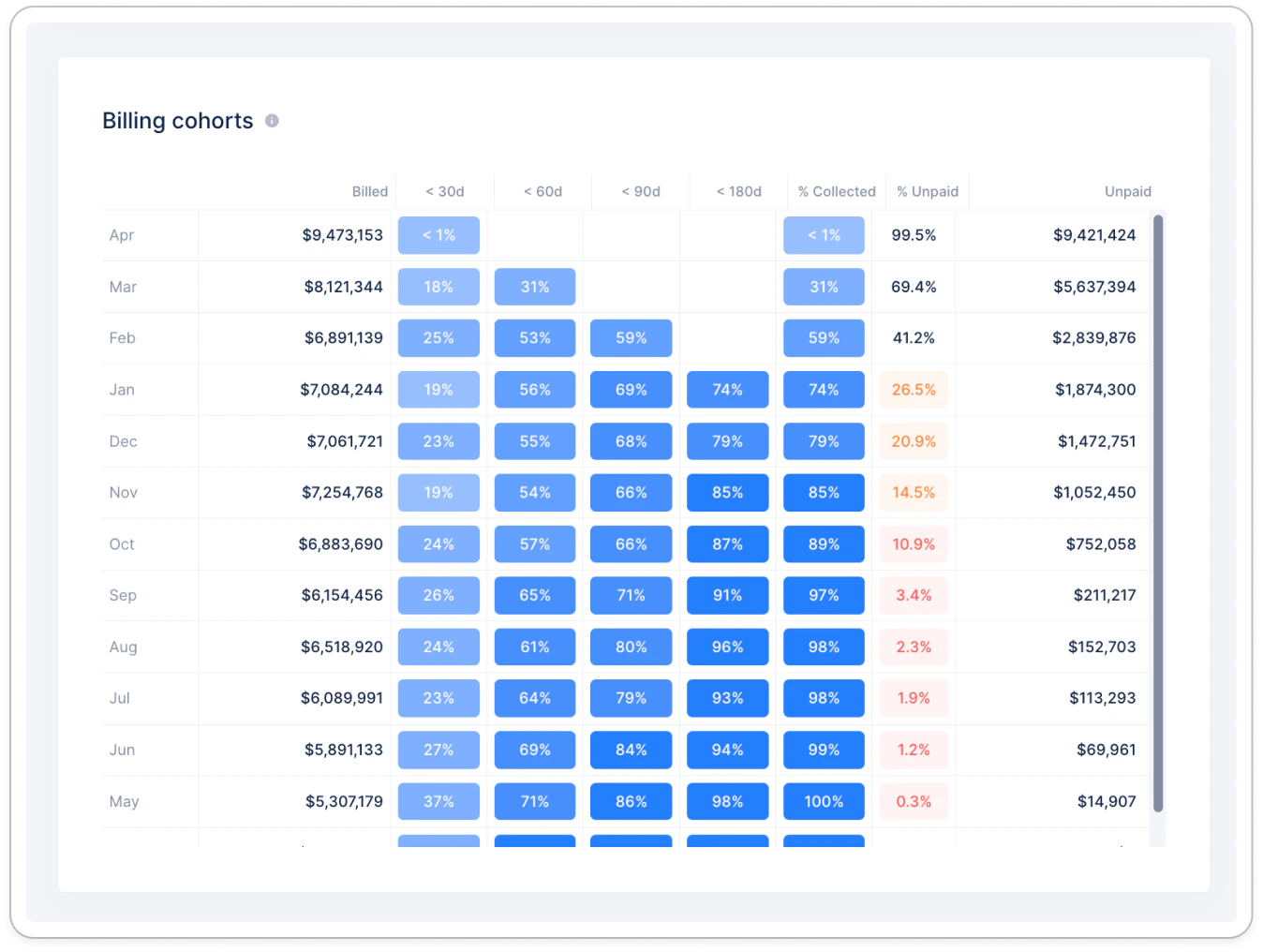
How to read a billing cohort?
There are two ways to read a billing cohort:- Left-to-right : this tells you how quickly the invoices in a given month were paid. The numbers are cumulative so they’ll always increase, but they should get to 100% quickly. In fact, in an ideal world, the 30-day bucket should be at 100%.
- Bottom-to-top : this allows you to understand how the speed at which you get paid evolves over time. For example, in the example above, in August, 24% of invoices were paid within 30 days, and in March of the following year, 18% of invoices were paid within the same amount of time. This means that you’re becoming less efficient at collections and that it’s probably time to make some process changes.
What is the exact calculation methodology?
-
Sales/Invoiced amounts : We sum the total amount of all the invoices billed during the corresponding months (based on the issue date)
- We exclude any draft invoices that you may have (NetSuite only)
- Written off invoices remain part of the Sales and are accounted as loss so they are displayed in the cohorts
- Collected percent : We divide the value of Payments + Credit Notes received corresponding to these invoices by the Sales
- Unpaid : we subtract what has been paid (payments + credit notes) from the Sales.